Showing posts with label High Plains. Show all posts

The Vanished Corn Farmers and a Cooler, Drier Future?

There is a lot of Apocalypse Porn going around, like in the closing of this article on the flooded shopping mall in Bangkok. Coastal inhabitants will be living in shacks on the roofs of flooded office buildings, etc. etc.

We have been telling the story of the Great Flood for at least 4,000 years, after all.

On the other hand, some researchers of solar-output cycles still see a better chance of a coming period that is cooler — and drier. Let's start with the story of some corn-growing prehistoric villages in what is now Iowa:
There were possibly over one thousand Indian villages on the Great Plains from Iowa to Colorado during the Medieval Warm Period. In the early 19th century when the explorers who spearheaded the European invasion of the American heartland crossed the plains, they found no corn-farming villages. They left behind the last of the agricultural tribes as they moved out onto the grasslands – the Akira and Mandan on the Missouri and the Pawnee in eastern Kansas – not to find corn fields again until reaching the Pueblos in the southern Rockies. Remnants of the villages were uncovered in the early 20th century as layers of debris covered by wind-blown soil.
In other words, the subsequent Little Ice Age made maize farming more and more difficult except in favored locations, and no one was doing it (except maybe at El Cuartelejo) much west of present-day Wichita.

The phrase "lower solar activity, and thus a posited colder climate" produced a lot of heat in the comments section, at least.
Blog Stew on Horseback

 ¶ Western dude ranchers are having to buy bigger horses for fatter guests.
"Little horses just aren't sturdy enough to hold up in a dude operation in the Rocky Mountains," Kipp Saile said, noting that about 15 of their 60 horses were Percheron mixes, the largest weighing 1,800 pounds.
¶ Colorado's oil and gas-drilling boom is polluting farm land (spills, drilling waste), and oil companies hope that microbes will clean up the hydrocarbons.
The number of spills reported by companies reached a 10-year peak of 578 last year (43 related to the September floods), contaminating an estimated 173,400 tons of topsoil, according to the COGCC data, which come from reports companies are required to file.

While energy companies responsible for spills recover much of the liquid hydrocarbons during cleanups, an analysis of the data shows that roughly 45 percent stays in soil.
¶ Never mind the propaganda about how corn-based ethanol is "patriotic." Even the business press, like Forbes, is moving to the position that ethanol is a loss overall. (Especially when you use High Plains Aquifer water to grow the corn.)

Some High Plains Bird News


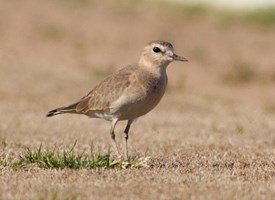
Mountain Plover (Cornell Univ.)
Another news story on the upcoming annual Kaval mountain plover festival. Or how a tiny farming town, fearful of federal regulation, learned to love a (not officially) threatened species.

Meanwhile, to the southeast, the lesser prairie chicken has been placed on the "threatened" list.
The prairie chicken, a type of grouse known for its colorful neck plume and stout build, has lost more than 80 percent of its traditional habitat, mostly because of human activity such as oil and gas drilling, ranching and construction of power lines and wind turbines, Ashe said. The bird, which weighs from 1 ½ to 2 pounds, has also been severely impacted by the region's ongoing drought.
Populations in Texas, Oklahoma, Kansas, Colorado and New Mexico are affected. Governors are upset. So when is the Lesser Prairie Chicken Festival?

You Can't Burn 'Em, You Can't Plow 'Em: SE Colorado's Tumbleweed Blizzard

Southeast Colorado county officials try to deal with the combination of blustery spring winds and last summer's bumper crop of tumbleweeds (Russian thistle).

Burning kills the seeds, but you cannot burn them when it is windy. And the various mulching solutions just scatter the seeds.

A Piñon Canyon "Armistice"

The big news in southern Colorado back in the late 1970s was the Army's search for a new training area for mechanized troops.
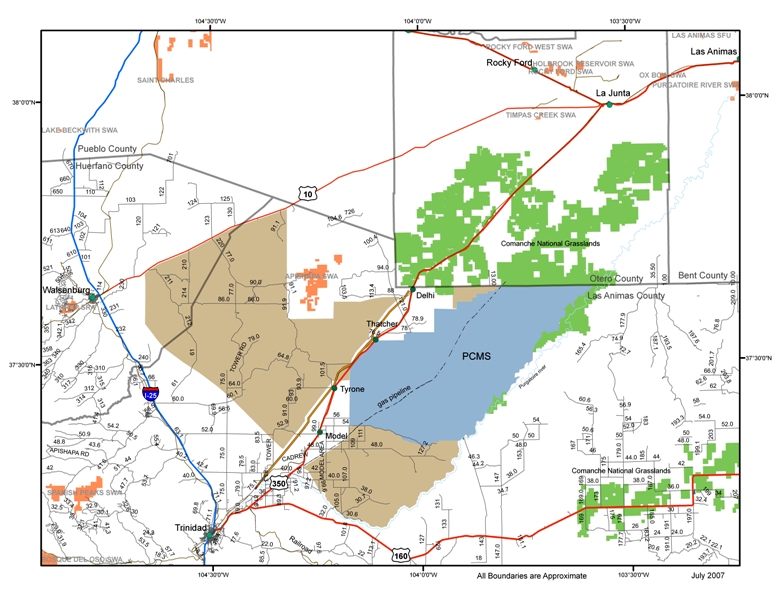
Blue is the current PCMS, brown the proposed expansion area.
Green areas are the Comanche National Grasslands (Wikicommons).

Fort Carson, formed during World War II (at the begging of city fathers who wanted soldiers' pay spent in Colorado Springs), was created by expropriating ranch land to create the 137,000-acre military reservation.

But it was not enough anymore, the Army said. They wanted another training area close enough to shuttle units back and forth. Various locations were suggested: South Park, the San Luis Valley, the High Plains.

The High Plains "won," and a new round of condemnations created the 235,896-acre Piñon Canyon Maneuver Site along the Purgatory River.

Some landowners took the money and ran, while others fought futilely against the federal government.

It's possible to hunt on PCMS, and my friend Eric and I took advantage of that to explore various archaeological sites, old and new. I remember walking into an abandoned house in the late 1980s and finding, for example, a 1977 Sears Roebuck catalog still lying on a kitchen counter, while kids' toys littered the living room floor. It was a sad scene.

At the same time, I had to admit that Army ownership gave those of us who jumped through a couple of bureaucratic hoops opportunities to explore country that we never could have entered before.

The Army's civilian wildlife specialists kept windmills pumping water for deer and antelope and lobbied to keep training activities out of "sensitive areas." One of them told me that they would mark off small wetlands, for example, with engineer's tape, and the troops were supposed to treat them as "minefields."

An area containing the now-famous dinosaur trackway was transferred to the U.S. Forest Service and opened to the public.

But generals kept hinting that they needed still more land — more than 400,000 acres — and local residents lobbied Colorado politicians to stop that. Homemade signs saying "This land is not for sale to the Army" went up in Otero, Las Animas, and other counties.

Late last November (I missed this at the time), the Army backed down.
At the urging of Sen. Mark Udall, a Boulder County Democrat, Army Assistant Secretary Katherine Hammack used the paperwork equivalent of a wooden stake to kill expansion plans for the 235,000-acre training site.

"It's kind of an emotional moment," said Las Animas County Commissioner Gary Hill, a rancher and neighbor of the training area who has been at war with the Army over expansion for years.
The Army's reason is that fewer troops means less need for training. But then they would never admit that the years of bad publicity, political conflict, and hard feelings mattered.

Furthermore, generals and assistant secretaries come and go, but the expansion plan, once written, can last for decades.

The Tumbleweed Menace

Colorado Springs Gazette columnist Bill Radford notices the tumbleweed hordes of 2013. 

Oh yeah. I am not one of those people who goes around mowing everything mowable — that is so Midwestern— but this year I mowed one little meadow that I had not touched in twenty years, because it was sprouting kochia and Russian thistle, the baddies:
In El Paso County, the two chief culprits are Russian thistle and kochia, [rancher Sharon] Pattee says. The Colorado State University Extension labels them both as "troublesome annual weeds of rangeland, pastures, fields, disturbed areas, gardens, roadsides, ditch banks and small acreages."

Both are non-native species. Russian thistle originated in, yep, Russia, and is believed to have come to the United States in the late 1800s through contaminated flax seed. Kochia is from Asia.
Tumbleweed Christmas trees? Been there, done that. One year when I was little, I was sick in bed during Christmas, so my older sisters decorated a big globe tumbleweed with glass ornaments and put it by my bed.

This was when we lived in Rapid City, S.D., where they were easy to come by.  This year in southern Colorado, every barbed wire fence looks like a fuzzy brown wall. Yeech.

Like Cattle, We Were Raised for Export

In a recent interview, Robert Rebein talks about his homeland — western Kansas, particularly Dodge City.

I think a couple of lessons have come [from the Dust Bowl of the 1930s]. The first lesson is that Kansas as a place is never going to be Texas or Colorado or Ohio. It’s too dry, too far from everything else, and the businesses that do best there—farming, ranching, energy exploration and production—do not require a lot of people. The other lesson is that if you do want to draw people and businesses to the state, you better try. You better understand that the lingering image of your state is a mix of the Dust Bowl, Superman, and The Wizard of Oz. If you want businesses to buy into you despite all that, you better put your best foot forward.
Here is the Vimeo trailer for Rebein's book, Dragging Wyatt Earp: A Personal History of Dodge City.

A west-Kansas blogger, Jeffro of The Poor Farm, was impressed by Rebein's book: "He has captured the essence of teenage prairie living, and in fact, life on the prairie, period, for all ages."

This passage hit him hard:
Wyatt Earp, the historical figure, really didn't make a dent in our lives. The street probably had more influence on us. But another observation Rebein makes really hit home for me:
What is it about growing up in a small town in the West that breeds such bravado, such innocence and blind faith? Was it our isolation? The vaunted self-reliance of the region? The fact that our parents and teachers praised us inordinately or that acceptance into any of the state colleges was a fait accompli? Maybe but I have another explanation:  we were leaving. And not just for a year or five years, but forever. Like the region's cattle, wheat and corn, we'd been raised for export, and most of us had learned this at about the same time we learned that Santa Claus was a fiction.  
We'd been raised for export.

It's true. Since day one, most of us knew that our parents wanted something better for us, that we were to get an education away from cattle and farming, and leave. Find a job we could love, get married and raise kids in a more forgiving climate.  

He has decided to stick it out, however. Some people do.

Not me. I go out on the prairie for hunting, for archaeological visits, or just because I must cross its expanse. Sometimes I just want to see the big sky. But I always feel a little like I am leaving a harbor in the foothills and sailing out onto the sea.

That probably comes of living as a kid on the "big island" that is the Black Hills, surrounded by wide-open country. The prairie is familiar, but it is not home.

This is What a Dust Bowl Looks Like

That fine, light High Plains soil blows and blows.  Photos at the link. If it were not in color, you would swear it was the Dirty Thirties again — although I do remember something like this from 1977.

High Plains Aquifers, Crop Changes, and the 'Secret Government'

I posted recently about the galloping depletion of the Ogallala Aquifer ("We're on the last kick," he said. "The bulk water is gone").

Chad Love explains how modern agricultural methods also make it harder for the aquifer to recharge itself: "The Ogallala is Ogaleavin' "

Here in Colorado, agriculture traditionally takes about 80 percent of the water and municipalities 20 percent, but that balance is changing as farmers sell or lease water to cities. Consequence: A shift to dryland crops, just as will probably happen on the High Plains where groundwater has been going to corn crops for ethanol, feedlots, and hog barns.

John Orr at Coyote Gulch links to a Greeley Tribune story on how winter wheat is supplanting other thirstier crops.

Back on my last newspaper job, my beat included the Southeastern Colorado Water Conservancy District. I always felt that "the water beat" was like being asked to cover the secret government — where decisions are made and court cases are fought that, years down the road, constrain what more visible government bodies can do.

Coyote Gulch is my go-to blog for secret-government news these days.

“We’re on the last kick,” he said. “The bulk water is gone.”

All my adult life, I have been hearing predictions that the Ogallala Aquifer (also called the High Plains Aquifer by people unsure how to pronounce "Ogallala"), a huge sponge of water under the High Plains, was dropping . . . dropping . . . dropping.

Fly east out of Colorado Springs and look at all the irrigated circles from center-pivot irrigation. They are growing corn, mostly.

Corn to feed to cattle in High Plains stockyards. Corn for ethanol (it's patriotic!) to make us energy independent so we won't be sending money to the Middle East.

All those wells pumping groundwater have led to this result.
Vast stretches of Texas farmland lying over the aquifer no longer support irrigation. In west-central Kansas, up to a fifth of the irrigated farmland along a 100-mile swath of the aquifer has already gone dry. In many other places, there no longer is enough water to supply farmers’ peak needs during Kansas’ scorching summers. . . . .

A shift to growing corn, a much thirstier crop than most, has only worsened matters. Driven by demand, speculation and a government mandate to produce biofuels, the price of corn has tripled since 2002, and Kansas farmers have responded by increasing the acreage of irrigated cornfields by nearly a fifth.  
From a US Geological Survey report, quoted at Coyote Gulch, the water blog:
The study shows that, since 2000, depletion of the High Plains aquifer appears to be continuing at a high rate. The depletion during the last 8 years of record (2001–2008, inclusive) is about 32 percent of the cumulative depletion in this aquifer during the entire 20th century. The annual rate of depletion during this recent period averaged about 10.2 cubic kilometers, roughly 2 percent of the volume of water in Lake Erie.
Maybe we will see more grass-fed beef (or buffalo?)  and more winter wheat in on the High Plains in the future. That's the optimistic outlook. But that slogan from the 1970s and 1980s, "A bushel of wheat for a barrel of oil!" is still just chest-thumping nonsense.
Older Post ►
 

Copyright 2011 Southern Rockies Nature is proudly powered by blogger.com