 |
| Click for larger image |
Showing posts with label drought. Show all posts
Showing posts with label drought. Show all posts
0
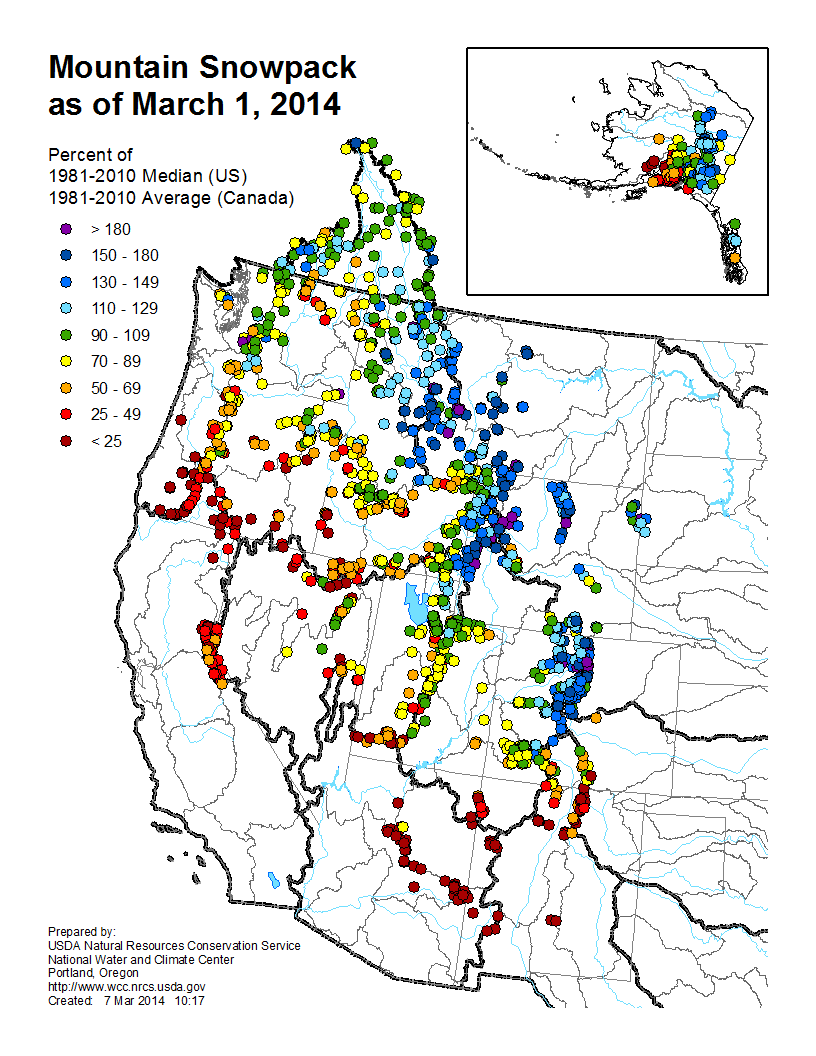
Western Drought Conditions as of July 1, 2014
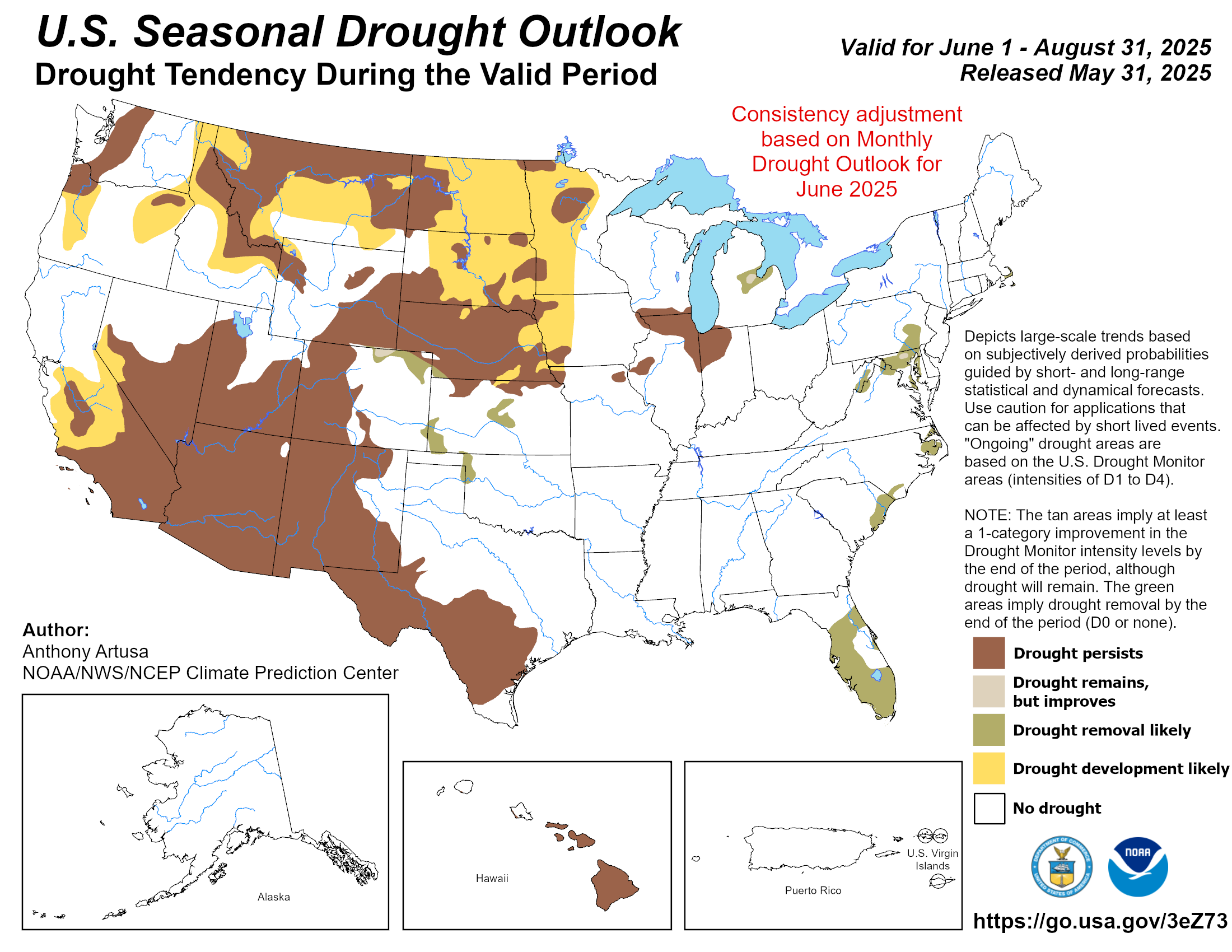
Seasonal Drought Outlook, June-September 2014
Cannabis and Water Law: A Western Reportorial Twofer
Despite the huge importance of water issues in Colorado — headwaters of four or five major rivers (depending how you count) and home of more water lawyers than anyplace — news outlets often don't cover water issues well.
On my first reporting job, at the now-vanished Colorado Springs Sun, it seemed like my colleagues found water issues to be arcane and scary. "Water is hard," to paraphrase Teen Talk Barbie.
On my second reporting job, I sat out to educate myself — with not a little help from the late Charles "Tommy" Thompson, long-time general manager of the Southeastern Colorado Water Conservancy District — or as I liked to think of it, the secret government.
The concepts of Colorado water law are fairly simple, but their permutations are endless, and the system operates like warring tribes — if you don't fight, you lose.
But add cannabis culture, and suddenly water issues are not just vital, they are sexy!
"Water District Votes Dry on Pot" (mostly paywalled)
"[Pueblo West] water available for pot growers; St. Charles Mesa keeping moratorium"
"Pot Shop Battles for Water Supply"
But this is all the legal stuff. Drought-stricken California sees legal, semi-legal, and outlaw grows using up water and polluting streams:
"Pot Farm Pollution: Too Dangerous to Deal With?"
"Study Finds Medical Pot Farms Draining Streams Dry"
On my first reporting job, at the now-vanished Colorado Springs Sun, it seemed like my colleagues found water issues to be arcane and scary. "Water is hard," to paraphrase Teen Talk Barbie.
On my second reporting job, I sat out to educate myself — with not a little help from the late Charles "Tommy" Thompson, long-time general manager of the Southeastern Colorado Water Conservancy District — or as I liked to think of it, the secret government.
The concepts of Colorado water law are fairly simple, but their permutations are endless, and the system operates like warring tribes — if you don't fight, you lose.
But add cannabis culture, and suddenly water issues are not just vital, they are sexy!
"Water District Votes Dry on Pot" (mostly paywalled)
"[Pueblo West] water available for pot growers; St. Charles Mesa keeping moratorium"
"Pot Shop Battles for Water Supply"
But this is all the legal stuff. Drought-stricken California sees legal, semi-legal, and outlaw grows using up water and polluting streams:
"Pot Farm Pollution: Too Dangerous to Deal With?"
"Study Finds Medical Pot Farms Draining Streams Dry"
Southern Colorado Drought Conditions Improve
 |
| Click to enlarge |
Drought Monitor, February 18, 2014

This is a screen shot. Go to the original site and you can select regional maps and see down to the county level.
In the Dust Bowl of 2014
 |
There is nothing to see in eastern Colorado. It's all flat and treeless. |

I was right about where the red arrow is pointing in the graphic from the United States Drought Monitor, and what was in theory a quail-hunting trip was, admit it or not, turning more into disaster tourism.
Outdoor writer Chad Love blogs from a location downwind of that location, and he has posted some photos that, once converted from color into black-and-white, evoke the Dirty Thirties.
I didn't photograph those six cows, nor the herd I saw somewhere on Colorado Hwy. 10 grazing in the slanting sunset light in a pasture that was about half dirt, even though it would have been nice and National Geographic-y. Like something from East Africa.
 |
| Windmill on the national grasslands. Not pumping. |
We drove on to another spot closer to the Purgatory River where there was a little water, but all we saw was a single mule deer slipping away. Very quiet. Very dry. Just a general sense of absence.
Chasing scaled quail involves a lot of a windshield time—and to be honest, I have done better in more agricultural areas, but this trip was degenerating into disaster tourism.
So I admitted that I was doing that, ate a late lunch of crackers and coffee, and drove around.
We drove past the Huerfano River Wind Farm outside Walsenburg—as usual for wind farms, not all the blades were turning—and Fisher got a piss break at Huerfano Butte.
And there is the mystery of those deserted commercial buildings on the gravel road in totally misnamed Apache City.
It was good to be back into the mountains and seeing snow.
Detail:
In the Dust Bowl of 2014
Reading Water Flows with Trees
Via Coyote Gulch, I learned about TreeFlow, a project to reconstruct centuries' worth of river flows in the West through correlating them with tree rings. "A tree-ring reconstruction is a best-estimate of past streamflows, based on the relationship between tree-ring data and observed streamflow over the modern period."
Here, for example, is the reconstruction of the Colorado River's flow at Lees Ferry, Arizona, going back to 750 CE (scroll down for that graph).
Closer to home, the Arkansas River at Cañon City, Colorado, from 1685–1987.
The process correlates tree rings with observed data from the late 19th century to the present, then projects the correlation back over older tree ring samples from cores or archaeological sites. More about the process here.
Here, for example, is the reconstruction of the Colorado River's flow at Lees Ferry, Arizona, going back to 750 CE (scroll down for that graph).
Closer to home, the Arkansas River at Cañon City, Colorado, from 1685–1987.
The process correlates tree rings with observed data from the late 19th century to the present, then projects the correlation back over older tree ring samples from cores or archaeological sites. More about the process here.
The persistent drought conditions that emerged across the West in 1999, especially the extreme drought year of 2002, indicated that the observed records of streamflow in the region did not capture the full range of natural hydrologic variability. This drought, along with increasing demands on water supplies led to a need to assess the range of drought conditions that were likely to occur. Tree-ring reconstructions of streamflow, extending several hundred years or longer, provide a more complete representation of past variability. Accordingly, streamflow reconstructions attracted more interest within the water management community as a potentially useful tool for planning.
Detail:
Reading Water Flows with Trees
Drought Conditions Improve in Colorado, New Mexico


The strong monsoon season has helped ease the drought. I see that our area has dropped from "severe drought" to "abnormally dry."
The creek near our house faltered in mid-summer but recovered before going completely dry. A rancher neighbor says that he has been able to irrigate for a few days, although I am sure that he would rather have had that water in June.
 |
| Denver Post photo |
In fact, in some areas, soil moisture has been recharged the old-fashioned way.
Then there is the oil-spill problem.
What Kind of Water Year Was It?
 |
| Click to enlarge |

Hydrologists measure "water years" from October through August, so this diagram shows the year that just ended.
Detail:
What Kind of Water Year Was It?
Hurray, Drought is only "Severe"

Stream flows are up, but soil moisture is still low in most places.
Detail:
Hurray, Drought is only "Severe"
How dry has it been? Tumbleweed Dry
I mowed the lawn at the guest cabin today — such is the payoff after having more than four inches of rain this month.
But it has been dry. How dry has it been? It has been so dry that the usual invasive weeds such as bindweed are gone, except around the flower bed where they can steal some water.
Instead, the area where all the grass died (previous owner planted bluegrass, which survived the late 1990s but not the 2000s) has been colonized by kochia and Russian thistle (tumblin' tumbleweed).
I have never seen tumbleweed growing around here before. I mowed every bit of it that I could find, hoping to stop it from flowering — the tumbling spreads its gazillions of seeds.
But it has been dry. How dry has it been? It has been so dry that the usual invasive weeds such as bindweed are gone, except around the flower bed where they can steal some water.
Instead, the area where all the grass died (previous owner planted bluegrass, which survived the late 1990s but not the 2000s) has been colonized by kochia and Russian thistle (tumblin' tumbleweed).
I have never seen tumbleweed growing around here before. I mowed every bit of it that I could find, hoping to stop it from flowering — the tumbling spreads its gazillions of seeds.
This is What a Dust Bowl Looks Like
That fine, light High Plains soil blows and blows. Photos at the link. If it were not in color, you would swear it was the Dirty Thirties again — although I do remember something like this from 1977.
New Mexico Drought Status Hits "Exceptional"

Subscribe to:
Posts
(
Atom
)