Showing posts with label conservation. Show all posts

Some High Plains Bird News


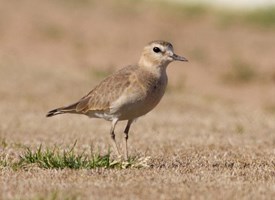
Mountain Plover (Cornell Univ.)
Another news story on the upcoming annual Kaval mountain plover festival. Or how a tiny farming town, fearful of federal regulation, learned to love a (not officially) threatened species.

Meanwhile, to the southeast, the lesser prairie chicken has been placed on the "threatened" list.
The prairie chicken, a type of grouse known for its colorful neck plume and stout build, has lost more than 80 percent of its traditional habitat, mostly because of human activity such as oil and gas drilling, ranching and construction of power lines and wind turbines, Ashe said. The bird, which weighs from 1 ½ to 2 pounds, has also been severely impacted by the region's ongoing drought.
Populations in Texas, Oklahoma, Kansas, Colorado and New Mexico are affected. Governors are upset. So when is the Lesser Prairie Chicken Festival?

Boots on the Ground: Backcountry Hunters & Anglers' 10-Year Climb

I spent last weekend at the national rendezvous of Backcountry Hunters & Anglers, and although I do not plan to write it up in a journalistic way, I have at least one post planned.

Meanwhile, here is a short video summarizing BHA's tenth anniversary. BHA went from a small group passing the whiskey around a campfire in Oregon to being a "player" in land and wildlife conservation.

Backcountry Rendezvous Comes to Denver!

In just ten days I will be traveling to Denver for the annual rendezvous of Backcountry Hunters and Anglers, a conservation group that while still pretty new, punches above its weight.

Let me pass the mike to outdoor/nature writer David Petersen, who was present at the creation:
"What hunting desperately needs," one of us opined, "is a national grass-roots sportsman's group comprising outdoorsmen and women who are sufficiently enlightened to put ecological integrity above all else, including our own self-interests." 
Indeed, what we were daydreaming about was a nonprofit organization built firmly upon Aldo Leopold's "land ethic." By "land," Leopold meant what we know today as the ecology -- including wildlife, fish and their habitats. "A thing is right," Leopold's land ethic proposed, "when it tends to preserve the integrity, stability, and beauty of the biotic community. It is wrong when it tends otherwise."
You may not realize how revolutionary a statement that is. There are other good conservation groups that put ecological integrity first yet are still comfortable with hunting or fishing—I think Trout Unlimited and Ducks Unlimited rank highly. TU in particular works to protect aquatic ecosystems that just happen to have Salmonids in them, which means most higher-elevation Colorado waters.

BHA's focus is protecting "backcountry" (not just designated draw-a-line-around-it wilderness areas) from disruptive motorized travel and anything else that negatively affects what lives there. And yes, these just happen to be good places to hunt and fish in traditional ways.

Dave continues,
And that's the briefest possible overview of how BHA came to be and who we are. Now let's fast-forward to March 21-23 -- next week! -- and the Red Lion Hotel Denver Southeast, where a now mature BHA with members in every state and several foreign countries, and 17 active chapters in the U.S. and Canada, is holding its third annual rendezvous and 10th birthday celebration. . . .
If you can't afford to spend the entire weekend with BHA members from all over America, you're most welcome to drop by on Friday evening, March 21, for kick-off events including a reception, vendor booths and displays, opening remarks by BHA Executive Director Land Tawney, dinner, and a get-acquainted "backcountry bash" featuring live bluegrass music.
 Here is a full schedule of events and registration information.

Pity the Sage Grouse, Victim of Politics

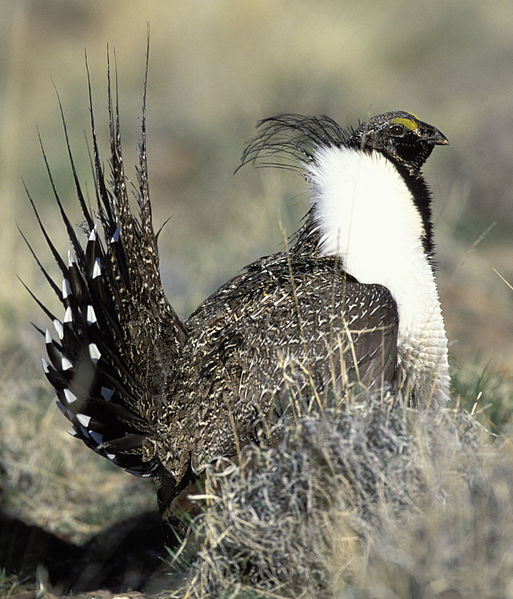
Sage Grouse (Wiki Commons)
Sally Jewell, shiny new Secretary of the Interior, comes to northwest Colorado to discuss the threats to sage grouse — then shuts local news reporters out of a "public meeting," is rebuked by the Colorado Press Association.

She has not been in office long, but evidently she has picked up this "most transparent administration's ever" operating style.

Later she issues a typical bureaucrat's non-apology in which it's no one's fault.

Forgotten in all of this: what, if anything, can be done to help the sage grouse. Secretary Jewell has managed to make the story all about her blunders instead.

Her trip was supposed to be about a local, ground-up plan to preserve sage grouse without listing them as endangered or threatened, with the associated federal regulations. But the controversy over Jewell's disrespecting of the local news media drowns that out. One might wonder why. With her way, people who did not personally attend the "public" meeting will never hear about how the local plan works and how the feds reacted to it.

Killing Eagles for Green Energy

Eagles are still federally protected — except when they get in the way of "green energy."

I have been fuming for two weeks, ever since reading that the Obama Administration signed off on letting wind farms kill them (not to mention other birds and bats) for the next thirty years:
Hundreds of thousands of birds die each year flying into the deadly turbine blades atop the soaring towers that compose wind farms. The rule will give wind farms thirty year permits for the “non purposeful take of eagles-that is where the take is associated with but not the purpose of, the activity.’’ The take of eagles is also a euphemism for the slaughter of them. (Video at the link)
Why, it's a "struggle to balance," notes the New York Times:
[The Obama Administration] has increasingly found itself caught between two staunch allies: the wind energy industry and environmental organizations. . . . “A 30-year permit is like a blank check,” said David Yarnold, president and chief executive of the National Audubon Society, which was involved in months of negotiations on the rule. “It basically says you can go operate these wind turbines and kill as many eagles as happen to die.”
And you can tell whose votes Obama's people take for granted.

Here in Colorado, the Danish wind-turbine firm Vestas threatens layoffs unless they keep getting federal tax breaks, and noted conservationist Senator Mark Udall is all for it, trumpeting how he is all about the tax credits:  "The wind production tax credit supports Made-in-America energy and jobs across Colorado."

I do think the day will come when we have something better than wind-energy— fuel cells the size of air conditioners or something else that generates fairly clean power around the clock and does not fill up thousands of square miles of land with bird-swatters.

Then people will look at wind farms the same way that we look at passenger zeppelins—an interesting technology that failed to work as advertised.

The Passing of "Dr. Trout," Robert Behnke

Robert Behnke (Phil Pister via Trout Unlimited)

Robert Behnke of Colorado State University, a leading conservationist and authority on trout and salmon, died last month.
Bob was best known for his interests in native trout conservation and taxonomy.  He was a traditional taxonomist and depended heavily on body morphology, color and spotting patterns, and the like to differentiate species and subspecies.  On this, he was a great authority.  Most of us depend on his seminal books: Native Trout of Western North America and Trout and Salmon of North America as the bibles of taxonomic and distributional studies for trout and salmon.  These are highly recommended for any trout enthusiast.
Colorado Trout Unlimited has a page up with more information and a place to share memories of him and his work.

Bison, Bears, and Wolves . . . in Europe

That buffalo (bison) in the photo banner up top is part of a private herd at the Wolf Springs Ranch in Huerfano County, Colorado. Where he is grazing is historic habitat, but the herd was re-introduced and built up by a wealthy rancher, Tom Redmond.

His distant relatives in eastern Europe, once almost extinct, are making a managed comeback in Poland and Belarus. So are some other species that seemed likely to be preserved only in museums and heraldry, says The Telegraph:
The European bison, which was extinct in the wild in Europe at the start of the 20th century, has increased by more than 3,000 per cent after a large-scale breeding and reintroduction programme. It now has particular strongholds in Belarus and Poland.
Brown bear numbers have doubled and the grey wolf population of Europe quadrupled between 1970 and 2005.
There were also sharp rises in numbers of several species of bird, including the Svalbard breeding population of the barnacle goose, the white-tailed eagle and the Spanish imperial eagle.
But tell me, did someone at The Telegraph use a stock photo of North American bison? Compare to these.For a moment I wondered if someone was cross-breeding our bison, but I don't think so. The website of the European Bison Conservation Center says, "The [captive breeding] program should ensure separation of the pure Lowland and the Lowland-Caucasian lines and avoid hybridization with any other related species."


New Hunters Not Joining Habitat-Protection Groups?

Hank Shaw, author of Hunt Gather Cook and the forthcoming Duck Duck Goose: The Ultimate Guide to Cooking Waterfowl, Both Farmed and Wild, worries that too many "locavore" and "adult-onset" hunters are failing to join conservation groups like Duck Unlimited or the Rocky Mountain Elk Foundation that protect wildlife habitat.

Is it a culture-war sort of thing?
There is a myth among new hunters that long-time hunters merely eat the choicest bits of an animal, leaving the rest to rot — if they eat the animal at all. I freely admit I used to think this way, a decade ago. While I’ve never had a problem getting along with people of all political stripes — I was a political reporter for nearly 20 years, after all — I certainly held my nose high when I heard about how this hunter or that angler cooked his or her quarry. But as I met more and more “traditional” hunters, and actually listened to them, I began to realize that even though they might not make a liver creme caramel from that whitetail they just brought home, they might still just cook up that liver in some butter, or grind it into sausage. And isn’t that the point? To eat it, and not to waste. Everything else is aesthetics.
It is this culture clash that lies at the root of a much larger dilemma. In my experience, the vast majority of the new hunters, or as my friend Tovar Cerulli calls them “adult-onset hunters,” either have never heard of the various habitat organizations organized around the animals they seek, or reject them as right-wing old boys’ clubs.

This is a grave error.
He offers two reasons for joining. One is that most of these groups are efficient charities that put the majority of their money into programs, not into salaries and further fundraising. Second, by being part of the hunting or angling community, you learn stuff and make connections.

I could speak to both sides of this question. While I support Ducks Unlimited or RMEF, for example, with occasional checks, a big banquet hall full of people I don't know is not a comfortable experience for me, although I have been to a few.

If my only connection with people is shared waterfowling or trout-fishing, it's hard to stay enthused. (I was president of a Trout Unlimited chapter once, not necessarily a good one.)

So staying home and writing checks is my contribution, as it working some with smaller, locally focused groups, because I support what they do, even though I last attended a DU banquet in about 1996.

I noticed the comments to Shaw's post ended up deteriorating into Republicans-vs.-Democrats stuff. That is another grave error.

Another Ski Trooper Conservationist Leaves a Legacy

Stuart Phelps Dodge, another of the World War II ski troopers from the 10th Mountain Division, has passed on, leaving a huge conservation legacy in El Paso and Teller counties, Colorado.
Dodge left his conservation footprint on countless open spaces, including the Garden of the Gods, Bear Creek Regional Park, the historic Palmer Blair Bridge, and the Christian Open Space contiguous with the south end of Fountain Creek Regional Park.

He helped build systems for acquiring those open lands to benefit landowners and the state.

"If you have walked any trails around here, he probably helped preserved them in perpetuity. The city would not be what it is if it hadn't been for him," said Linda Overlin, former president of the Palmer Land Trust. "He was an instrumental part of the conservation easement movement statewide in the 1980s and 1990s to preserve open spaces."
It is amazing how much of what we grew up accepting as "normal Colorado" was shaped and affected by that group of men — in the case of David Brower, much more than just Colorado.

Mediterranean Diet: The Dark Side

You have the olive oil, of course, and the seafood and the vegetables.

And the golden orioles, the nightingales, and the corncrakes. The larks and the finches, yum yum.

Call it a quirk of geography. Birds that migrate from Europe to Africa must cross the Mediterranean Sea, north to south or south to north. They are tired after that flight, easy to trap and kill, be it in Egypt, the Greek islands, Crete, Sicily, or the south of France.

In Egypt, for example, 
A few scattered nets along the coast have metastasized into a nearly impenetrable wall of traps, stretching almost without break from the Gaza strip in the east to the Libyan border in the west. Conservative estimates set the annual death toll of migratory birds in this area at 10 million, but others say it is probably an order of magnitude more.

In some areas, especially near Libya, the birds are caught for subsistence, by people who currently have no other way to feed themselves, but the vast majority, perhaps 80 percent of the birds trapped, are sold in markets as a pricey delicacy or hocked to high-end restaurants in Cairo for up to five euros for each slight songbird. 
This Mediterranean taste for songbird pasta sauce came to America and contributed to the shaping of American hunting regulations. Just as Americans were trying to move away from the "shoot everything" approach to conservation-guided hunting, along came the Italians (mainly) who got jobs, bought shotguns, took a train ride out into the country, and started shooting chickadees.

Louis Warren, writing in The Hunter's Game: Poachers and Conservationists in Twentieth-Century America, devotes a chapter to this cultural conflict:
Because Italian immigrants hunted birds, they were considered a principal threat to bird life and therefore an incipient cause of this potential apocalypse. In the minds of many, immigrants represented as much a threat to American nature, especially American birds, as they did to the social order of American cities. William T. Hornaday, the president of the New York Zoological Society and one of the most famous conservationists of the era, captured conservationists' fears of Italians in his widely read tract, Our Vanishing Wildlife: "Let every state and province in America look out sharply for the bird-killing foreigner; for sooner or later, he will surely attack your wild life. The Italians are spreading, spreading, spreading. If you are without them to-day, to-morrow they will be around you." 
In 1903, the influential conservation magazine Forest and Stream published an article, "The Italian and the Birds," noting,
Once I examined the contents of a bag that one of a party of three Italian hunters [in Massachusetts] carried and found nearly fifty birds, including two or three quails, which at that season were unlawfully taken, and among the song birds that constituted the greater portion of what the bag contained were several chickadees, a bird that with its feathers off is not much larger than an English walnut. I have learned that the Italians are in the habit of killing and eating chickadees and all other song birds, and for this purpose will snatch the young from their nests before they can fly.
Today, hunting regulations in America are better respected, and what transgressions take place usually take different forms. The French may even stop eating songbirds too.

Unfortunately, contemporary Egypt is a pretty dysfunctional nation that cannot even feed itself. (To think that Egypt fed parts of the Roman Empire at one time!) So bird conservation is pretty far down the to-do list, after massacring Coptic Christians and what-not.
Older Post ►
 

Copyright 2011 Southern Rockies Nature is proudly powered by blogger.com