
Showing posts with label snow. Show all posts
Showing posts with label snow. Show all posts
0
Colorado Snowpack, February 25, 2015
Waiting for Some Snow
 |
| Click to embiggen. |
January is an important month for mountain precipitation over the course of the average year.The month of Apriltypically provides the most mountain precipitation at 3.6 inches, followed by March at 3.4 inches, and January coming in the third highest at 3.2 inches. This January provided only 1.47 inches of mountain precipitation, 45% of the average. The South Platte saw the greatest precipitation totals compared to normal at 62% of average.Here in the foothills, I have had my snowblower out only three times, and the deepest snow was only seven inches. (Via Coyote Gulch, the go-to Colorado water blog.)
Detail:
Waiting for Some Snow
Yes, It's Pretty, But We're Sick of It

Four days of freezing fog in the last week. M. is complaining loudly that it's too icy for her daily walks. Sometimes, even gravel and bare dirt are slick. This is completely un-Southern Colorado, and we do not like it.

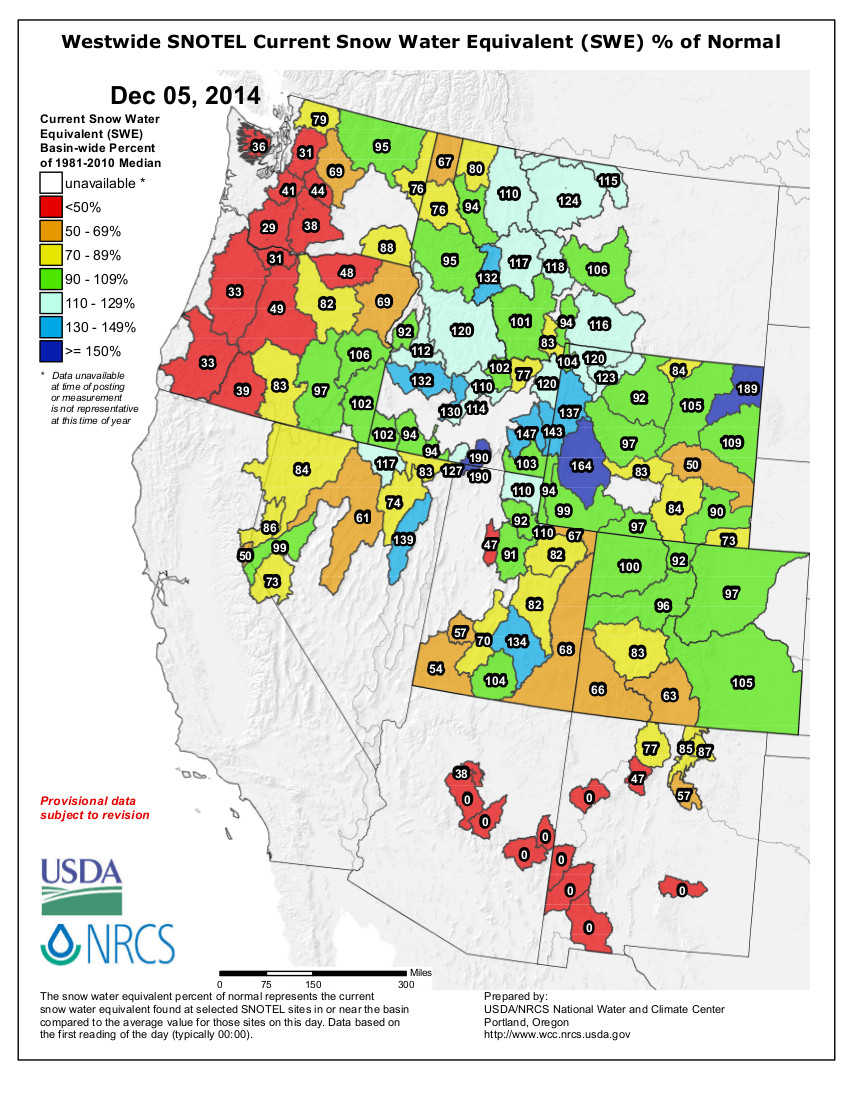
Southern Colorado Drought Conditions Improve
 |
| Click to enlarge |
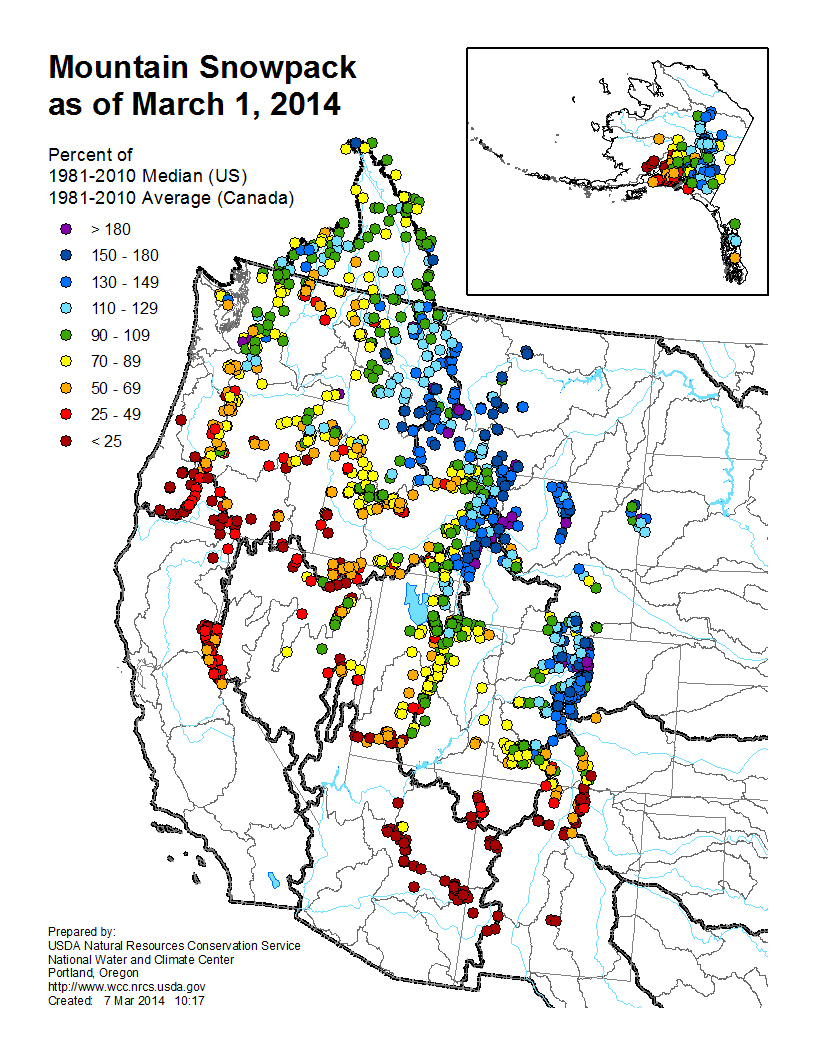
Mountain Snow Pack, February 1, 2014

Testing Tipis in the Jet Stream
 |
| 16-man tipi and woodpile (Photo: Jamie Marchbank) |
Berger writes, "The sheltering quality of social order becomes especially evident if one looks at the marginal situations in the life of the individual, that is, at situations in which he is driven close to or beyond the boundaries of the order that determines his routine, everyday existence"
Such as winter camping, for example — definitely not part of my everyday existence.
Ira Chernus, a religious-studies professor at CU-Boulder, summarizes what Berger means by "the canopy":
What we want more than anything else, according to this sociological view, is to be in balance--to have a permanent stable order in our lives, so that we can predict both the environment and the responses to it that we and others around us will choose. Society's main project is to create this sense of stable predictable order and to make all of us believe in it, although in fact it is always a false illusion.We want a stable order, yes, which means that the tent stays up. But in one sudden 60 mph-or-higher blast, the high-tech "16-man" cooking/dining tipi, centerpiece of the annual Colorado Kifaru Winter Rendezvous, has simply vanished — and I lay in my sleeping bag, looking up at an angry murky sky, semi-illuminated by the Moon.
The canopy, sacred or otherwise, was gone. Stability was a false illusion.
Up, out of the sleeping bag, pulling on my boots, I made sure that the fabric had not snagged on the wood-burning stove — now tipped on its side — that still held a few embers.
Plan A, check with Kevin, my near neighbor, who had an "8-man" tipi set up. I turned that way and—where was the tipi? It was down too, and its stove had tumbled a pot of melting snow onto his sleeping bag. Luckily, the temperature was only slightly below freezing, and so Kevin had covered his sleeping bag with a bivvy sack, zipped it up, and planned to deal with everything in the morning.
Since I had no bivvy sack, my Plan B was to wrap up in the tent fabric like a human tamale and wait out the night.
Then I saw a head lamp moving over in another direction. Another tent was down. It was Eric's, and he had room, so I traded help in re-rigging his small tipi for shelter space. By shoveling snow around the edges, we cut down on the ground blizzards that were moving through the tent.
Kifaru's tipis should have stood up to that wind, and in fact, not every one of them went down. For the big tent — maybe the others too – I blame the fact that it was erected late in the afternoon, and the snow had not really set up around the long snow pins. We re-did it the next morning, making everything extra-taut and weighting down the edges with snow, and it did fine.
 |
| Eric cooking in the snow cave's vestibule. |
Snow caves are so quiet. You can hear yourself blink.
Detail:
Testing Tipis in the Jet Stream
Blog Stew Spit from Nozzles
¶ In Switzerland, says BLDGBLOG, winter is sculpted "by one wizard-like figure who is really just a stoned twenty-something in a wool hat, turning different parameters on and off and spraying whole new European landscapes into existence outside."
¶ Staying with Europe for a moment, this article comes from the British newspaper The Telegraph, but it is written by an American and reveals, among other things, what teenage girls do in hunting blinds. "How one nature lover was converted to deer-hunting: Could an ethically minded carnivore be converted to the law of the gun in his pursuit of organic meat in the Mississippi Delta?"
¶ How people panic during a disaster, most of them anyway. (Via Peter "Bayou Renaissance Man" Grant.)
¶ Staying with Europe for a moment, this article comes from the British newspaper The Telegraph, but it is written by an American and reveals, among other things, what teenage girls do in hunting blinds. "How one nature lover was converted to deer-hunting: Could an ethically minded carnivore be converted to the law of the gun in his pursuit of organic meat in the Mississippi Delta?"
¶ How people panic during a disaster, most of them anyway. (Via Peter "Bayou Renaissance Man" Grant.)
Detail:
Blog Stew Spit from Nozzles
Mountain Snowpack, January 1, 2013

You can view previous winters' maps here. For Colorado, links to individual SNOTEL stations are here.
* Official explanation: "Due to data system changes and resource constraints, basin-filled maps for SNOTEL & Snow Course Snow Water Equivalent are no longer being produced and are replaced by point maps."
Sleeping in the Cold
A young guy in northern Minnesota decides to try sleeping outdoors for a year in the back yard. He started out in a kind of tree house, but then winter came.
I have done some winter camping, but a year—I respect that.
M's and my second dwelling was a sort-of-winterized little house in Manitou Springs. We slept in an unheated, uninsulated sun porch. It did have glass windows—jalousies that did not seal too well and let little patches of snow drift in.
But our rule was that when the temperature in our bedroom dipped much below 20° F (-7° C), we would move into the indoor guest room.
The snow house smelled like straw, which littered the white floor. In this holiday season, Hummel seemed to be occupying his own Nativity scene.Lots of foam pads, that's the secret. (Via Free Range Kids.)
I have done some winter camping, but a year—I respect that.
M's and my second dwelling was a sort-of-winterized little house in Manitou Springs. We slept in an unheated, uninsulated sun porch. It did have glass windows—jalousies that did not seal too well and let little patches of snow drift in.
But our rule was that when the temperature in our bedroom dipped much below 20° F (-7° C), we would move into the indoor guest room.
Detail:
Sleeping in the Cold
Here Is Your Winter

Detail:
Here Is Your Winter
Winter Camping in the Age of Ignorance
I was skimming this article (and its informed comments) about temperature rating on winter
sleeping bags and how many manufacturers (in the writer's opinion) overstate them. In other words, a bag rated to -20° F (-28° C) is really more like a -10° bag for a man — maybe a -5° bag for a woman.
With the temperatures hovering around 0° F. outdoors, I remembered my first serious winter camping trip and sleeping in a Korean War-surplus M1949 "down and feathers" mummy bag.
That was not the worst of it. Compared to the rest of my gear, that was a high-tech sleeping bag.
My Boy Scout troop went to the annual Winter Camporee, held in Rocky Mountain National Park — near Bear Lake, I think. I was about 12 years old.
The troop supplied canvas tents, while we Scouts brought our own personal gear. Maybe if Dad had been around, he could have offered good advice and some of his own stuff — he got me started on camping and backpacking, after all — but at this point, the marriage was dissolving, and he was living elsewhere.
As I recall, I was equipped with cotton long underwear, probably cotton socks, cotton blue jeans, some kind of shirt and sweater (?), a not-great ski parka, knit hat, and mittens. On my feet were oiled leather pull-on boots, "Wellingtons" in the American sense of the word. They leaked.
If you had a down parka back then, you were probably a pro mountaineer, like Jim Whittaker on Mount Everest, or else had the money to pretend to be one.
Under my M1949 sleeping bag was a plastic-covered foam-rubber pad off a patio chaise longue. And maybe a GI poncho.
I shivered through the night and spent part of the morning standing next to the campfire that was slowly sinking down, down into the snow. (We "cooked" on campfires, as I recall).
I learned some things right away, such as that blue jeans freeze, and since there were no outhouses, just the woods, you can spend hours working up the courage to take a shit in the snow.
On the plus side, I spent a lot of time snowshoeing, and that plus the bright Colorado sunshine warmed me up. The snowshoes kept my inadequate boots up out of the snow as well.
The second evening, the Scout leaders loaded us into their cars and took us to some Park Service building where we watched a natural-history movie. I suspected even at the time that the real reason for the trip was to let us spend a couple of hours inside a heated structure.
I made a few improvements to my bed, survived the second night, and ran in the snowshoe races the next day. And then it was time to head home. I thought that I had had a good time overall, and I proudly sewed the Winter Camporee patch onto my uniform.
 |
| This looks like my childhood sleeping bag. |
With the temperatures hovering around 0° F. outdoors, I remembered my first serious winter camping trip and sleeping in a Korean War-surplus M1949 "down and feathers" mummy bag.
That was not the worst of it. Compared to the rest of my gear, that was a high-tech sleeping bag.
My Boy Scout troop went to the annual Winter Camporee, held in Rocky Mountain National Park — near Bear Lake, I think. I was about 12 years old.
The troop supplied canvas tents, while we Scouts brought our own personal gear. Maybe if Dad had been around, he could have offered good advice and some of his own stuff — he got me started on camping and backpacking, after all — but at this point, the marriage was dissolving, and he was living elsewhere.
As I recall, I was equipped with cotton long underwear, probably cotton socks, cotton blue jeans, some kind of shirt and sweater (?), a not-great ski parka, knit hat, and mittens. On my feet were oiled leather pull-on boots, "Wellingtons" in the American sense of the word. They leaked.
If you had a down parka back then, you were probably a pro mountaineer, like Jim Whittaker on Mount Everest, or else had the money to pretend to be one.
Under my M1949 sleeping bag was a plastic-covered foam-rubber pad off a patio chaise longue. And maybe a GI poncho.
I shivered through the night and spent part of the morning standing next to the campfire that was slowly sinking down, down into the snow. (We "cooked" on campfires, as I recall).
I learned some things right away, such as that blue jeans freeze, and since there were no outhouses, just the woods, you can spend hours working up the courage to take a shit in the snow.
On the plus side, I spent a lot of time snowshoeing, and that plus the bright Colorado sunshine warmed me up. The snowshoes kept my inadequate boots up out of the snow as well.
The second evening, the Scout leaders loaded us into their cars and took us to some Park Service building where we watched a natural-history movie. I suspected even at the time that the real reason for the trip was to let us spend a couple of hours inside a heated structure.
I made a few improvements to my bed, survived the second night, and ran in the snowshoe races the next day. And then it was time to head home. I thought that I had had a good time overall, and I proudly sewed the Winter Camporee patch onto my uniform.
Blog Stew for Free-Range Kids and Tactical Barbequers
¶ A northwest section has been added to the Colorado Birding Trail. The "trail" is a series of wildlife-watching stops and driving loops. Here is the site for all the "trails."
¶ Exurban Kevin rounds up some of the "tactical" Christmas-gift ideas out there. A MOLLE-gear barbeque apron? Tactical paper? I never go hiking without it.
¶ It snowed last week in Walsenburg too. With photos.
¶ No MOLLE gear, but check out "A Terrible Mother's Holiday Guide to Dangerous Gifts," via Lenore Skenazy's Free Range Kids blog.
¶ Exurban Kevin rounds up some of the "tactical" Christmas-gift ideas out there. A MOLLE-gear barbeque apron? Tactical paper? I never go hiking without it.
¶ It snowed last week in Walsenburg too. With photos.
¶ No MOLLE gear, but check out "A Terrible Mother's Holiday Guide to Dangerous Gifts," via Lenore Skenazy's Free Range Kids blog.
Turkeys in the Snow


It's tough being a ground-feeding bird in snowy weather, which is why they usually for south-facing slopes and other places that melt out early. The monsoon rains this summer brought on a good crop of native grass seed, which they will eat when it is exposed — and I have mixed feelings about that. Sure, turkeys got to eat, but I wanted to see some of that blue grama etc. germinate and fill in the bare places.
Sure, my opinion matters a lot to the turkeys!
Meanwhile, the snow. The first county road we take on the way home was fairly clear, but the second was icy. At the right moment, I popped the Jeep into 4WD and gunned it for the first little hill in our unplowed driveway, making the first turn and slewing in S-curves through its dips and rises (must get new tires!) up to the house.
Wind and freeze-thaw cycles had made the snow compact and granular, hard to shovel and too chunky for my big snow-blower. More sunny days and cold nights have turned the tire tracks into ice ribbons. If more snow falls soon on top of them, the result won't be pleasant.
Detail:
Turkeys in the Snow
Olympic National Park: Hurricane Ridge
The present
Walking around the Hurricane Ridge parking lot and then up the trail, I felt that my energy level was high. In fact, I was congratulating myself at how bouncy I felt up there at timberline. Then Rational Mind kicked in: "Dude, you're at a lower altitude than your house."
Timberline is so much lower there, thanks to latitude and whatever other climactic factors. The visitor center is at 5,242 feet (1,911 varas, 1,598 meters), in other words, the same as the high plains city of Denver. Mt. Olympus is 6,900 feet but gets massive snowfall as storms sweep off the North Pacific.
The past
Driving up to the ridge, I was trying to remember and reconstruct the last time I had entered Olympic National Park. It was between my freshman and sophomore year of college, and my girlfriend and I had driven up from Portland for a quick backpacking trip in her Volkswagen squareback.
Did we car-camp the first night in the park? I know we hiked to some lake — Lake Angeles? Why did we go there? What did we eat? What did we talk about? All I can remember is camping beside some lake in the forest. And the "green tunnel" effect of driving on the Olympic Peninsula, which still struck me even after my first year in western Oregon.
I was keeping a journal then, but I can't consult it, for it was one of the volumes that my mother trashed (and then lied about it) after I left them in my old desk at her house. So it goes.
Walking around the Hurricane Ridge parking lot and then up the trail, I felt that my energy level was high. In fact, I was congratulating myself at how bouncy I felt up there at timberline. Then Rational Mind kicked in: "Dude, you're at a lower altitude than your house."
 | |
| Hurricane Ridge visitor center, with Mount Olympus in the background |
 |
| Trail in the Hurricane Ridge area |
 |
| Looking north: the white streak is a cloud bank on the Strait of Juan de Fuca, while the dark strip on the horizon is Vancouver Island. |
Driving up to the ridge, I was trying to remember and reconstruct the last time I had entered Olympic National Park. It was between my freshman and sophomore year of college, and my girlfriend and I had driven up from Portland for a quick backpacking trip in her Volkswagen squareback.
Did we car-camp the first night in the park? I know we hiked to some lake — Lake Angeles? Why did we go there? What did we eat? What did we talk about? All I can remember is camping beside some lake in the forest. And the "green tunnel" effect of driving on the Olympic Peninsula, which still struck me even after my first year in western Oregon.
I was keeping a journal then, but I can't consult it, for it was one of the volumes that my mother trashed (and then lied about it) after I left them in my old desk at her house. So it goes.
What Killed the Russian Skiers? (2)
 |
| The torn tent at the skiers' campsite |
This article offers another telling and more photographs, but the mystery remains. (Note: the page is "safe for work," but some networks may block the overall Vice.com website.)
If the tent was struck by an avalanche, how did they get out? People have died under relatively small amounts of snow — a foot or two — when it was heavily compacted.How come the skis used as tent poles are still standing if an avalanche swept over it? And was that even an avalanche-prone slope?
Wouldn't experienced backcountry skiers who survived an avalanche have not reconstructed their camp as best they could?
I keep thinking that the radiation readings might be misleading, not the real issue — but that is just conjecture.
M. wonders if they did not eat bad mushrooms. That seems as possible as anything. Since it was February, someone would have had to make an error while picking mushrooms in the forest the previous season, then bring them along in dried form to be reconstituted and cooked in a stew or something. That could possibly explain the apparent delirium. Maybe.
Mountain Snowpack, May 1, 2013
 |
| Click to enlarge. |
Detail:
Mountain Snowpack, May 1, 2013
Subscribe to:
Posts
(
Atom
)