Showing posts with label wolves. Show all posts

How Not To Become Prey

Bears biting backpackers. Mountain lions munching mountain bikers.

Every time that some carnivorous critter bites or kills a human, there will be voices proclaiming, "They were here first. We live on their territory."

That is true in a long historical view —  and it is also true that human populations have lived alongside big carnivores throughout history — but Wyoming writer Cat Urbigkit's new book, When Man Becomes Prey: Fatal Encounters with America's Most Feared Predators, adds some nuance and some new information.

Her book is divided into species-specific chapters
  • Black bears
  • Coyotes
  • Gray wolves
  • Mountain lions
  • Grizzly nightmares
  • Greater Yellowstone grizzlies
plus two more, "Habituation and Alaska Attacks" and "Learning to Coexist with Predators."

Each chapter begins with some narratives, the kind that you want to read in the daytime with a clear view of your surroundings. They then cover relevant scientific research and practical ways to avoid conflict with bears, mountain lions, or whatever. "For some hikers [in coyote habitat] rocks-in-pockets becomes a routine at the start of every hike."

For instance, I was raised to believe that while they were a threat to dogs and cats, coyotes left adult-size humans alone. Urbigkit leads with the 2009 killing of Taylor Mitchell in Cape Breton Highlands National Park by a small pack of three coyotes — all healthy. "Wildlife officials suspected that these coyotes had become habituated to humans during the tourist season, and this may have involved the animals receiving food rewards from humans." (There have been other attacks on children and adults , but she was the only recorded adult human fatality.)

Attacks on pets, even leashed dogs with people, are also increasing. Geographically, coyote attacks seem most common in parks, where no hunting is allowed, and into urban areas, again without hunting and with a variety of food resources.

A certain degree of hunting, she suggests, does encourage predators to stay away from people. Yet with mountain lions, for instance, "wildlife managers believe that when heavy localized hunting results in the harvest of older mature males, more young mountain lions are likely to disperse into those areas, creating an increase in [lion-human] conflicts."

Some other take-aways:

• While people think that black bear sows with cubs are the most dangerous, "the majority of the fatal attacks on humans involved male bears, and most attacks took place during the daylight hours." While most black bears are shy, some do prey on humans deliberately. Also, "no one killed in a black bear attack carried bear spray."

• Urbigkit, who lives on a sheep ranch south of Grand Teton National Park, believes in bear spray: "You don't have to be an excellent shot to be effective with a can of bear spray — a cloud of spray between you and a charging bear should be enough for your immediate retreat from the area."

She also offers a case where bear spray stopped an attacking mountain lion. I myself have used it only on aggressive dogs, where it worked well, so I suspect that it would work just as well on a wolf or coyote.

• There are no documented cases of black bears attacking humans in defense of a carcass, but as Northern Rockies hunters are learning, grizzlies, where present have done that a number of times.

• The old idea, from books like Jim Corbett's Man-Eaters of Kumaon (1944), is that the predators who attack humans are usually elderly, crippled, or wounded. With grizzly bears, that is sometimes true, Urbigkit writes. But there also more North American predators than there used to be, thanks to recovery programs and more-regulated hunting. In addition, we have created such predator-friendly places as parks and food-rich subdivisions.

Consequently, they become habituated to us — and we become habituated to them, sometimes forgetting that they "are not loveable toys to be enjoyed when convenient [Yellowstone wolf tours?] and then discarded or destroyed when they reveal their true natures.

"Predators should be treated with a realistic acknowledgment that they are animals that kill prey to survive, and should be respected for the wild creatures that they are."

Any backcountry hiker or hunter, anyone who visits parks like Yellowstone or Great Smokies, and anyone who sees bears, coyotes, or deer in their neighborhoods — where there are deer, there are lions — ought to read When Man Becomes Prey.

It is available from the publisher, Lyons Press, or from the usual online source.

Wolves on the Colorado Ballot?

Gray wolf (Montana Fish, Wildlife & Parks photo).
Colorado is known for its frequent citizen initiatives to change its constitution, which is why the state constitution is now almost as long as the Boulder telephone book.

In a discussion of the ecological phenomenon of the "trophic cascade" at Colorado College last night, noted conservation biologist Michael Soulé mentioned that plans are afoot to try to pass a new constitutional modification requiring the re-introduction of wolves.

It would certainly pass on the urban Front Range, he predicted sensibly, although on the Western Slope (he lives in Paonia himself), its chances would not be so good.

Evidently there is some serious foundation money lining up behind this initiative. So stock up on popcorn now, because this could be interesting.

Where would these furry ecological saints be re-introduced? He did not say, although I got the impression that Rocky Mountain National Park would be one obvious candidate.

Hunting Season? Your Dog Needs "Isa-tai"

Does your dog go into the woods during hunting season? Does he dart off the trail, refuse to come to the whistle, and then you find him gulping fat and guts where someone field-dressed a deer or elk — no doubt thinking that bears or coyotes would clean up the pile?

Does he then get diarrhea or, twenty-four hours later, throw up a mass of fat the size of both your fists together and stand over it growling because he thinks that he is going to re-eat it?

Most of the time, your dog eats food out of a sack, supplemented by whatever he can steal off the kitchen counters. He lacks the right blend of beneficial intestinal bacteria for digesting elk guts, hair, hide, etc.

He needs Isa-tai!*

Here at Hunt-Pro Labs, we start with the fresh feces of wild Wyoming wolves. We culture the bacteria and package it in clean, odorless capsules. A short course of Isa-tai and your dog will be able to digest everything that he finds in the woods, short of Amanita muscaria.**

He'll be a happier dog, and you won't have to clean up messes!

Isa-tai, for dogs who run a little wild!


* Isa-tai was a Comanche warrior active in the 1870s on the Southern Plains. His name translates to Wolf Shit, although an alternative translation is wolf's (or coyote's) vagina. Anyway, the name is a tribute.

** For that you want milk thistle.

Bison, Bears, and Wolves . . . in Europe

That buffalo (bison) in the photo banner up top is part of a private herd at the Wolf Springs Ranch in Huerfano County, Colorado. Where he is grazing is historic habitat, but the herd was re-introduced and built up by a wealthy rancher, Tom Redmond.

His distant relatives in eastern Europe, once almost extinct, are making a managed comeback in Poland and Belarus. So are some other species that seemed likely to be preserved only in museums and heraldry, says The Telegraph:
The European bison, which was extinct in the wild in Europe at the start of the 20th century, has increased by more than 3,000 per cent after a large-scale breeding and reintroduction programme. It now has particular strongholds in Belarus and Poland.
Brown bear numbers have doubled and the grey wolf population of Europe quadrupled between 1970 and 2005.
There were also sharp rises in numbers of several species of bird, including the Svalbard breeding population of the barnacle goose, the white-tailed eagle and the Spanish imperial eagle.
But tell me, did someone at The Telegraph use a stock photo of North American bison? Compare to these.For a moment I wondered if someone was cross-breeding our bison, but I don't think so. The website of the European Bison Conservation Center says, "The [captive breeding] program should ensure separation of the pure Lowland and the Lowland-Caucasian lines and avoid hybridization with any other related species."


Rena and the Wolves

I am on the road. So go read Wyoming sheep rancher Cat Urbigkit's story of her livestock guardian dog Rena's battle with a wolf pack.

Colorado and Utah Fought Wolf Protection Plan


(I missed this item last month, but got the link from Cat Urbigkit's Wolf Watch.)

Documents obtained show that Colorado and Utah state wildlife officials strongly opposed federal plans to declare gray wolves "endangered" (hence protected) in those states if and when the wolves showed up.
The documents suggest the animal's fate was decided through political bargaining between state and federal officials, said Jeff Ruch, executive director of Public Employees for Environmental Responsibility.

The nonprofit group obtained the records through a freedom of information lawsuit and provided them to The Associated Press.

"In simplest terms, these documents detail how the gray wolf lost a popularity contest among wildlife managers," Ruch said. . . . .
The administration's plan unveiled earlier this month [June 2013] would declare gray wolves are only endangered in a relatively small part of the Southwest inhabited by a few dozen Mexican wolves — a subspecies of the gray wolf.
To quote again from the US Fish and Wildlife service's news release, "The Service is also proposing to maintain protection and expand recovery efforts for the Mexican wolf (Canis lupus baileyi) in the Southwest, where it remains endangered"

And that was the area under contention, apparently.

Colorado does not have any wolves, officially, although isolated individuals have wandered down from Wyoming. (Pet wolves or wolf-dog hybrids have also been released, another issue.) I have heard tales of wild wolves roaming on the Western Slope as far back as the 1980s, before they were reintroduced in Yellowstone National Park, but those tales remain just that. 

Why resist federal protection? The usual reasons: fear of reduced deer and elk herds, hence hunting-license revenue loss; fear of attacks on livestock, be that at traditional cattle ranches or New West-ish alpaca operations; fear of attacks on people.

Mange, Distemper Hit Yellowstone Wolves

An online Scientific American article says that both canine distemper and sarcoptic mange are affecting wolf populations in Yellowstone National Park and surrounding areas.

I could not help but think of the unlucky coyote pup we transported last Wednesday. It seems likely that the distemper caused him to fall behind, be abandoned, and be discovered by a person who wanted to help him.

Heroes Are Made, Not Born

I am not sure where the division of society into "sheep," "sheepdogs," and "wolves" began, but the author of this three-part series, "Are You a Sheep or a Sheepdog" attributes it to the author Dave Grossman.

Part 1: Are You a Sheep or a Sheepdog?

Part 2: 8 Reason's You're Hardwired for Sheepness

Part 3: Your Roadmap to Becoming a Sheepdog.

Whatever the source, it's a useful classification system. And as the author notes, we are mostly born "sheep."
Grossman isn’t using the term pejoratively, he’s simply referring to the fact that most human beings are kind, gentle, and peaceful. The conflicts and ethical dilemmas they’re regularly faced with rarely rise to the level of life and death, good versus evil. For the most part people deal with challenges that are more annoyances than true crises. And when faced with conflict, they generally try to do the right thing, avoid making waves, and demonstrate pro-social behavior.
We are followers. We don't trust our intuition. We think, "It can't happen here." We suffer from "normalcy bias" and the "bystander effect."
33-year firefighting veteran Jack Rowley saw normalcy bias play out on a regular basis at bars in Columbus, Ohio. Fires were surprisingly common at bars on Saturday nights and whenever Rrowley showed up, he’d see smoke quickly filling up the establishment. But instead of mayhem, he’d find folks just sitting at the bar “nursing their beers.” He’d ask them to evacuate and the customers would say, “No, we’ll be just fine.”
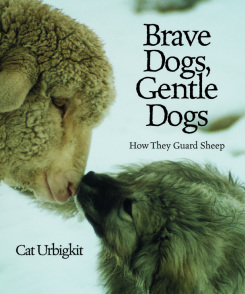
Speaking of the real sheepdogs, Wyoming sheep rancher and writer Cat Urbigkit is in the middle of lambing season, and her livestock guardian dogs are earning their keep. (That is one of her book covers up above.)
Older Post ►
 

Copyright 2011 Southern Rockies Nature is proudly powered by blogger.com